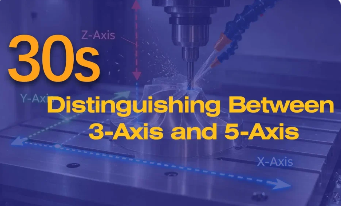
A 3-axis CNC machine operates along three linear axes: X, Y, and Z. The tool moves along these axes to perform machining. It is suitable for flat parts, simple contours, and standard holes. standard holes, making it ideal for many standard CNC machining applications. 3-axis machines are cost-effective, easy to operate, and stable in production, making them ideal for high-volume standard parts. Understanding the basics helps buyers evaluate whether a supplier can meet regular part production needs without overspending on unnecessarily advanced equipment.
Key Features: Moves only in a flat plane
Appearance: Fixed table, tool always vertical
Simple Analogy: Like a cake decorating turntable or pottery wheel, only flat-plane operation
Applicable Parts: Flat parts, simple molds, mechanical components
What is a 5-Axis CNC Machine?
A 5-axis CNC machine adds two rotational axes (A/B or C axes) to the standard three linear axes. The tool or table can tilt and rotate, enabling machining of complex surfaces and angled features. complex surfaces and angled features, which are typically handled by advanced 5-axis CNC machining services. For suppliers in aerospace, automotive, or precision mold industries, 5-axis machines are essential for high-precision, multi-angle machining. Recognizing these features helps buyers plan production, optimize workflows, reduce multiple setups and errors, and improve batch efficiency and part quality.

Key Features: Tool or table can rotate and tilt
Appearance: Table or spindle rotates; complex structure
Simple Analogy: Like a camera mounted on a gimbal
Applicable Parts: Complex curved parts, aerospace components, deep cavity molds
How to Quickly Distinguish CNC Machines by Appearance
Method 1: Check the Worktable
- Not rotating = 3-axis
- Rotates/tilts = 5-axis
Method 2: Check the Tool Orientation
- Always vertical = 3-axis
- Can tilt = 5-axis
Method 3: Check the Machine Structure
- Simple, flat-plane design = 3-axis
- Has rotary axes or tilting head = 5-axis
Comparison Table: 3-Axis vs 5-Axis CNC
| Feature | 3-Axis CNC | 5-Axis CNC |
| Motion Axes | X/Y/Z | X/Y/Z + 2 rotary axes |
| Tool Angle | Fixed vertical | Tilted at multiple angles |
| Worktable | Fixed | Rotates/Tilts |
| Number of Setups | Multiple | Fewer (one setup completes machining) |
| Suitable Parts | Simple flat parts | Complex curved or deep cavity parts |
| Cost | Low | High |
| Programming Difficulty | Simple | High |
Distinguishing by Application
Typical Applications of 3-Axis CNC
3-axis machines are widely used for flat parts, mechanical components, standard molds, and basic sheet metal. They are ideal for high-volume, low-complexity production, offering stable output and easy maintenance. For bulk procurement, 3-axis machines are sufficient for standard parts orders. Understanding these applications helps buyers assess supplier capabilities and pricing fairness.
Typical Applications of 5-Axis CNC
5-axis machines are extensively used in aerospace, automotive, high-precision molds, and medical device industries. They can complete complex surfaces and multi-angle features in a single setup. Buyers assessing suppliers for bulk orders should consider the number and configuration of 5-axis machines to ensure complex parts can be machined efficiently in one setup, reducing rework, saving production time, and guaranteeing high-precision part delivery.
Summary
Core Differences: Number of motion axes, machining angles, machining complexity
Quick Memory Tip:
- Doesn’t rotate, tool stays vertical = 3-axis
- Rotates, tool can tilt = 5-axis
One-Sentence Analogy: 3-axis is like a pottery wheel, 5-axis is like a camera on a gimbal
Frequently Asked Questions (FAQ)
- Can 3-axis machines handle complex parts?
- Only flat or simple parts; multi-angle surfaces require 5-axis.
- Is 5-axis always better than 3-axis?
- Not necessarily; 5-axis is for complex parts, 3-axis is more cost-effective for standard parts.
- How to identify a 5-axis machine on-site?
- Look for a table that rotates/tilts or a tool that can tilt in multiple angles.
- Are 5-axis machines suitable for high-volume production?
- Yes for complex parts; for simple parts, 3-axis can be more efficient.
- Do 5-axis machines reduce setups?
- Yes, multi-angle machining is often completed in one setup.