Medical device manufacturers must use high-precision CNC parts because medical equipment is directly tied to human health and patient safety, and precision components are the foundation of equipment accuracy, operational stability, safety, and compliance.
That is the conclusion up front.
This is not a matter of “only high-end equipment needs it,” nor is it something to consider only when the budget allows. In the medical device industry, part accuracy is never an optional upgrade. It is a baseline condition for safe operation, successful certification, and stable long-term delivery. Once part deviation moves beyond a controllable range, the consequences rarely stop at rework or scrap. It can directly affect test results, surgical performance, sealing reliability, and even patient safety.
So when medical device manufacturers choose high-precision CNC parts, they are not simply pursuing something “more refined.” They are managing risk. Clinical risk. Compliance risk. Brand risk. After-sales risk as well.
For medical device manufacturers, R&D teams, and supply chain managers sourcing in volume, what really needs to be understood is not the simplistic idea that “higher precision is always better.” The real questions are these: Why are high-precision CNC parts a necessary investment, where exactly does their value show up, and how can you tell whether a supplier truly has medical-grade precision machining capability? Let’s break that down clearly.

1. Why the Medical Device Industry Is So Sensitive to Part Accuracy
Many industries talk about precision machining, but the medical device industry is noticeably more sensitive to accuracy than most. The reason is not complicated. It sits too close to the human body, too close to risk, and too close to regulation.
1.1 Medical Devices Are Not Ordinary Industrial Equipment
When an ordinary industrial machine develops deviation, the typical outcome may be reduced efficiency, a shutdown for repair, or a part remake.
When a medical device develops deviation, the consequences are often far more serious.
If the fit clearance in a minimally invasive surgical instrument is off, it can directly affect a surgeon’s tactile feedback and insertion accuracy. If a critical internal component in a diagnostic instrument drifts dimensionally, the data may drift with it. If the sealing structure in an infusion or respiratory support device has even a minor deviation, the result may be leakage, pressure loss, or even increased infection risk.
So the medical device industry does not ask for something that is merely “basically usable.” It requires operation that is consistently accurate, stable, and verifiable.
1.2 The Cost of Failure in Medical Devices Is Far Higher Than in General Manufacturing
This is also why many medical customers are more cautious than ordinary industrial buyers when evaluating suppliers early on.
Because they are not looking only at machining capability.
They are looking at the cost of failure.
If a part lacks sufficient precision and causes the finished device to fail final inspection before shipment, that is only the first layer of loss. The deeper losses may include certification delays, postponed clinical validation, batch recalls, damage to brand reputation, and even legal liability. Those costs are far greater than the added manufacturing investment required to make the part properly in the first place.
2. What High-Precision CNC Parts Are, and Why They Are Especially Suitable for Medical Devices
To understand this topic, the term “high-precision CNC part” must first be defined clearly. Otherwise, the discussion stays stuck at the level of slogans.
2.1 The Core Definition of High-Precision CNC Parts
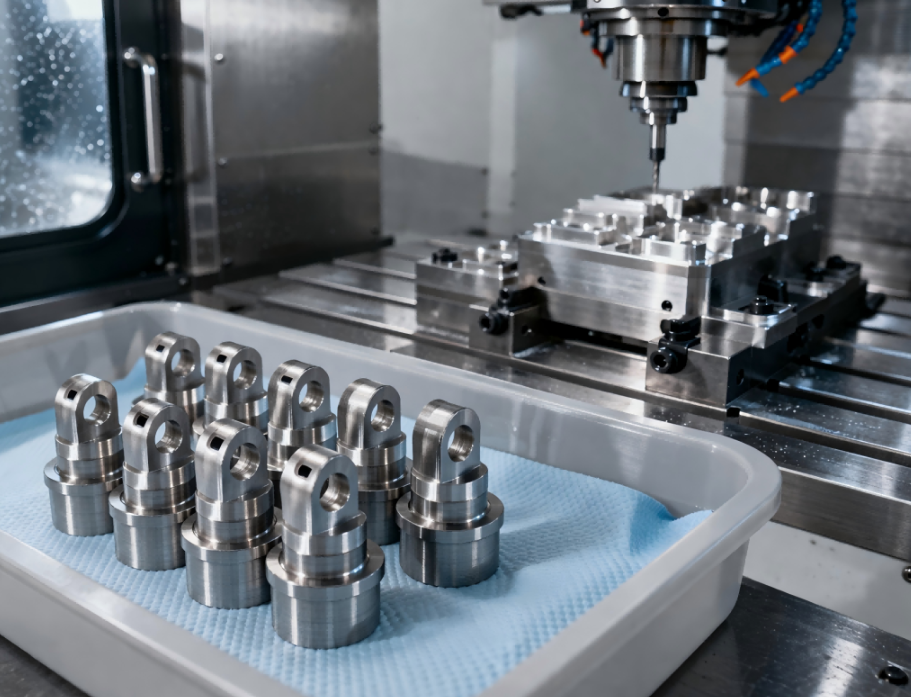
High-precision CNC parts generally refer to mechanical components produced through precision machining methods such as CNC turning, milling, grinding, drilling, tapping, or five-axis machining, with dimensional error, geometric tolerance, surface roughness, and consistency controlled to a high standard.
In medical device applications, the key is not just that the part is “made accurately.” Several conditions must hold true at the same time:
- dimensions must be accurate
- geometric tolerances must remain stable
- surfaces must be controlled
- batch consistency must be high
- material performance must remain stable
- follow-up inspection must be traceable
A single sample that looks beautiful is not enough.
What medical devices truly depend on is repeatability at production scale.
2.2 Why Precision CNC Machining Is Especially Suitable for Medical Device Manufacturing
Medical device parts often share several obvious characteristics:
- small structures
- tight tolerances
- assembly sensitivity
- demanding surface requirements
- strict material requirements
- strong need for batch consistency
And CNC machining happens to excel at exactly these issues. High-precision turn-mill processing, micro-machining, five-axis machining of complex surfaces, thin-wall part machining, and highly consistent batch replication all align naturally with the manufacturing demands of medical devices.
3. Why Medical Device Manufacturers Must Use High-Precision CNC Parts
This is the most critical section of the article. These parts are not merely “recommended.” They are not just a value-added feature. In many projects, they are a basic requirement.
3.1 First, They Protect Patient Safety
This is the primary premise. It is also the starting point for the entire discussion.
Once a medical device enters clinical use, diagnostics, implantation, or therapeutic support, its parts are no longer just elements of a mechanical system. They become part of a safety system. Even a connector, guide part, seal, or moving interface can trigger abnormal equipment behavior if dimensional deviation, deformation, fit, or surface defects exceed acceptable limits.
Typical risks include:
- surgical instruments sticking or moving inaccurately
- diagnostic equipment producing biased readings
- leakage in infusion, respiratory, or related devices
- instability in sterile component connections
- excessive wear in critical motion parts
Many incidents are not caused by a flawed design. They happen because the part was not manufactured to the design requirement.
The drawing was correct.
The actual part was not correct enough.
That is where the risk begins.
3.2 Second, They Meet the Precision Operating Requirements of the Equipment Itself
In medical equipment, precision is rarely an abstract concept. It is tied to every movement, every reading, and every fit relationship.
For example:
- minimally invasive surgical instruments require smooth motion and precise feedback
- glucose meters and similar diagnostic devices require stable structure and internal positioning
- certain support, guide, and retention structures inside imaging equipment require high consistency
- respiratory and infusion-related equipment requires reliable fluid paths and sealing structures
What all of these devices share is this: their tolerance for error is extremely low.
A standard part may “fit into the assembly,” but that does not mean it will allow the device to function reliably.
The value of a high-precision CNC part lies in the fact that it not only fits, but continues to support the intended working condition over time.
3.3 Third, They Help Meet Strict Regulatory and Testing Requirements
The medical device industry has a very practical rule: making a product is not enough. You must prove that it was made correctly, consistently, and traceably.
That means the part level also has to stand up to verification.
Whether it is material source, dimensional tolerance, surface quality, process inspection, or batch consistency, medical device manufacturing usually demands stricter records and testing logic. Insufficient part precision is not just a performance issue. It can directly affect registration, certification, and the pass rate of third-party testing.
High-precision CNC parts matter not only because they are “machined more finely,” but because they are far easier to integrate into a manufacturing system that is verifiable, auditable, and traceable.
That is critical for bringing a medical product to market.
3.4 At the Same Time, They Significantly Improve Equipment Stability and Service Life
Medical equipment is often not used occasionally. It runs frequently, continuously, and repeatedly. In hospitals, laboratories, rehabilitation equipment, and routine diagnostic systems in particular, usage frequency is high, which means higher demands on wear, fit clearance stability, and long-term reliability.
This is where the advantages of precision parts become even more visible:
- fit clearances are more appropriate
- friction and wear are easier to control
- operation is smoother
- failure rates are lower
- service life is more predictable
This matters not only to the end user, but to the manufacturer as well. When equipment becomes more stable, after-sales cost goes down. When repair rates fall, brand trust rises.
3.5 Finally, They Support the Industry Trend Toward Smaller and More Advanced Medical Devices
The direction of medical device development is already clear: smaller, lighter, more precise, and more intelligent.
Examples include:
- portable diagnostic devices
- wearable medical devices
- minimally invasive instruments
- highly integrated precision support equipment
- advanced domestic alternatives to imported medical systems
These products all face the same challenge: structures are becoming more compact, functions more complex, and the room left for part deviation is becoming smaller and smaller. The old machining mindset of “close enough to assemble” is no longer sufficient. Many advanced medical devices are difficult not because the design cannot be conceived, but because the precision parts cannot be made well enough.
So high-precision CNC parts are not just part of current manufacturing requirements. They are also part of the future competitiveness of medical devices.
4. Typical Applications of High-Precision CNC Parts in Medical Devices
If we discuss only abstract value, the importance still may not feel intuitive enough. So let’s look at practical applications directly.
4.1 Surgical Instruments
Minimally invasive surgical blades, hemostatic forceps, staplers, guides, gripping structures, and similar tools all depend heavily on part accuracy.
These instruments operate directly on human tissue, so movement must be smooth, positioning must be exact, and edges and contact surfaces must remain controlled. Any excess clearance, localized runout, assembly deviation, or surface imperfection can translate into clinical risk.
4.2 Diagnostic Instruments
Glucose meters, blood pressure devices, in vitro diagnostic equipment, certain analytical instruments, and related imaging components are equally sensitive to part precision.
Here, the core issue is not cutting motion. It is data reliability.
If a structural component is unstable, internal positioning drifts.
And once positioning drifts, the measurement result may drift too.
So in this kind of product, high-precision CNC parts do more than provide structural support. They help preserve measurement accuracy.
4.3 Implantable Devices and Related Components
Artificial joint-related structural parts, components for certain implant systems, and cardiovascular support parts all place extremely high demands on dimensions, surface condition, and material quality.
That is because these parts eventually remain in long-term contact with the human body, or they form critical interfaces within implant systems. Their manufacturing precision and surface condition cannot be vague or approximate. Even small deviations may affect implant fit, assembly precision, or long-term stability.
4.4 Auxiliary Equipment
Infusion pumps, ventilators, fluid-control devices, and certain connectors, seal-mating structures, guides, and supports used in monitoring equipment also rely heavily on high-precision machining.
These devices may not appear especially “high-end” on the surface, but their requirements are far from low. Many of them operate continuously for long periods, and once sealing instability, loose connections, or accelerated local wear appear, the effect is immediate.
5. What Medical Device Manufacturers Should Prioritize When Selecting High-Precision CNC Parts
Not every supplier that claims to do precision machining is actually suitable for medical device projects. During selection, several key points must be understood clearly.
5.1 Look First at the Precision Standard, Not Just the Equipment List
Many suppliers emphasize machine models, axis count, and equipment brands.
Those things certainly matter.
But what matters even more is the level of result they can consistently deliver.
Procurement and engineering teams should clarify:
- dimensional tolerance requirements
- geometric tolerance requirements
- surface roughness requirements
- batch consistency requirements
- critical fit region requirements
Especially in medical projects, many key parts should be judged first by micron-level control capability, not by a vague statement like “our equipment is very advanced.”
5.2 Then Look at Material Compatibility Capability
Medical devices do not rely only on ordinary metals.
Many projects involve:
- medical-grade stainless steel
- titanium alloys
- specific grades of aluminum alloy
- certain high-performance engineering plastics
- material systems that must balance corrosion resistance, biocompatibility, or cleanliness requirements
If high-precision machining capability is not combined with a real understanding of materials, it becomes easy to run into problems such as surface damage, deformation, poor burr control, or unstable thermal effects during processing. A truly qualified supplier must understand both precision and material behavior.
5.3 Also Assess Whether the Supplier Has a Medical-Manufacturing Mindset
This is not just about certificates. Qualifications, certifications, and quality systems are certainly important, but the deeper issue is whether the supplier truly understands how medical device projects work.
For example:
- can they maintain process records as required
- do they take batch consistency seriously
- do they have a disciplined inspection logic
- can they manage details such as cleanliness, burrs, and sharp edges
- do they understand that traceability is not paperwork, but a real requirement
What medical device projects fear most is a machine shop that treats them like ordinary industrial parts.
At the beginning, that may not look like a problem.
Later on, it usually becomes the biggest problem.
6. Two of the Most Common Misconceptions, and Why So Many Projects Get Stuck Here
6.1 Misconception One: Standard CNC Parts Can Be Used as an Acceptable Substitute
They cannot.
Ordinary CNC parts may achieve the basic shape, but if their precision, geometric accuracy, surface quality, and consistency do not meet the requirement, they will not satisfy the safety and stability needs of medical devices, and they will be even less likely to pass later industry testing and certification.
Many substitution ideas appear to save money, but in reality they are simply pushing the risk downstream.
Into testing.
Into customer complaints.
Sometimes even into recall territory.
6.2 Misconception Two: If the Cost Is High, Precision Requirements Can Be Reduced Moderately
That is also not advisable.
In medical projects, precision is not a nice-to-have cost item. It is a baseline requirement. Saving a little machining cost today by lowering accuracy may later cost far more in failures, repairs, after-sales issues, failed certification, or damage to market reputation.
So for medical device manufacturers, high-precision CNC parts are never just an added cost.
They are a way to reduce much larger costs.
7. Conclusion: High-Precision CNC Parts Are Not Optional. They Are a Basic Requirement for Medical Device Manufacturing
At the end of the day, the answer to why medical device manufacturers need high-precision CNC parts is very clear:
Because medical devices cannot tolerate the systemic risk created by low-precision parts.
The core value of high-precision CNC parts is not just that they are “machined more finely.” It is that they simultaneously support four critical things:
- patient safety
- precise equipment operation
- regulatory compliance
- long-term stability
Looking ahead, they also support the industry’s move toward smaller, more advanced devices, domestic substitution of imported systems, and highly consistent batch delivery.
So for medical device manufacturers, using high-precision CNC parts is not an increase in cost.
It is a necessary investment.
An investment in risk reduction. In compliance. And in real product competitiveness.
FAQ Section
8. Frequently Asked Questions
8.1 Why Can’t Medical Devices Use Standard CNC Parts?
Because standard CNC parts usually cannot consistently meet the demanding requirements medical devices place on dimensional accuracy, geometric tolerances, surface quality, and batch consistency. Once part deviation exceeds a controllable range, device safety, measurement accuracy, and compliance pass rates may all be affected.
8.2 Is the Value of High-Precision CNC Parts Limited to Better Dimensional Accuracy?
No. In addition to tighter dimensions, high-precision CNC parts directly affect assembly stability, smooth operation, sealing reliability, wear performance, batch consistency, and the feasibility of downstream testing and certification.
8.3 What Materials Commonly Used in Medical Devices Are Well Suited to Precision Machining?
Common examples include medical-grade stainless steel, titanium alloys, specific aluminum alloys, and certain high-performance engineering plastics. The right material should be selected based on biocompatibility, corrosion resistance, structural strength, and machining stability together.
8.4 What Should Medical Device Manufacturers Focus on Most When Choosing a Part Supplier?
The three most important areas are usually precision control capability, material processing experience, and quality management systems. More specifically, manufacturers should also evaluate whether the supplier truly understands the medical industry’s demands for consistency, traceability, and detail control.
8.5 High-Precision CNC Parts Cost More. Are They Really Worth It?
Yes. In medical devices, spending more upfront on precision control often significantly reduces much larger downstream losses from repairs, failures, failed certification, recalls, and brand risk.
8.6 Which Medical Devices Depend Most Heavily on High-Precision CNC Parts?
Minimally invasive surgical instruments, diagnostic devices, implant-related components, infusion pumps, ventilators, and other equipment that requires tight control of sealing, guiding, positioning, and very small structural features all depend heavily on high-precision CNC parts.