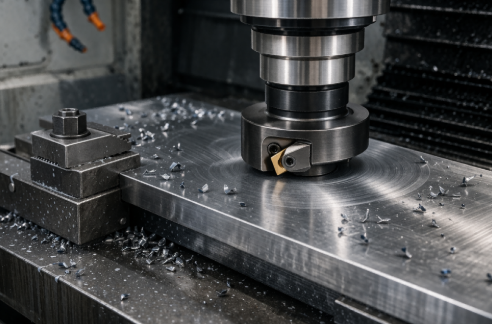
This article explains the definition, structural components, common classifications, core advantages, typical applications, cutting parameters, common problems, and maintenance tips for fly cutter tools, making it a practical reference for engineering, purchasing, and manufacturing teams.
A fly cutter tool is, at its core, a high-efficiency CNC milling tool made up of a cutter head and replaceable inserts, with the rotating cutter head driving the inserts to perform the cut. It is not at its best in small, deep, complex cavities. What it really excels at is large-area face milling, step milling, and certain contour milling operations. If your goal is efficient stock removal, stable machining of large flat surfaces, and better control of batch production cycle time, a fly cutter is often more suitable than a standard end mill. That is the conclusion.
When many people first encounter a fly cutter, they think of it simply as “a large milling cutter with a few inserts installed.”
That is not entirely wrong.
But it is far from complete.
Because the real value of a fly cutter is not just that “the cutter head is large.” More importantly, it uses a wider cutting coverage area, a more controllable insert consumption model, and higher batch machining efficiency to solve the productivity bottlenecks that traditional single-edge or solid tools often face in large-area machining.
For molds, mechanical parts, extrusions, plate components, large structural parts, and projects that repeatedly require machining broad flat surfaces and steps, a fly cutter is often not merely an option. In many cases, it is the most realistic efficiency tool available. Choose it well, and cycle time improves dramatically. Choose it poorly, and chatter marks, insert chipping, dimensional fluctuation, and rising cost usually follow.

1. Start with the Conclusion: What Is a Fly Cutter Tool?
If you want the most direct summary possible, a fly cutter tool is this:
A high-efficiency milling tool that uses a cutter head to drive multiple inserts in rotation, allowing a larger cutting diameter to cover a wider machining area in a single pass.
Where does it most commonly appear?
- face roughing
- large-area finish milling
- step surface machining
- surface finishing on large workpieces
- flat-surface machining for batch parts
So the core difference between a fly cutter and an end mill is not just external shape. It is machining logic.
An end mill is more like a flexible small cutting tool.
A fly cutter is more like a high-efficiency large-area advancing tool.
2. What Are the Core Structural Elements of a Fly Cutter Tool?
Whether a fly cutter performs well does not depend on the name. It depends on whether the structural design, assembly accuracy, and insert matching are all done properly. In most cases, a complete fly cutter tool consists of the following key parts.
2.1 Cutter Head
The cutter head is the core load-bearing component of the fly cutter and the main body of the tool as a whole. It holds the inserts in place and provides cutting radius and overall rigidity during rotation.
Cutter heads are available in different diameters, from relatively small sizes to large-diameter heads, and each size suits a different machining range. The larger the cutter head, the larger the area covered per revolution, and in many cases, the higher the machining efficiency. At the same time, however, the demands on machine power, rigidity, and setup stability also increase.
So the cutter head is not better just because it is larger.
It is better when it is better matched.
2.2 Inserts
One of the most typical characteristics of a fly cutter is that its inserts are replaceable.
These inserts are usually made from carbide, though coated inserts for specific conditions, highly sharp inserts for aluminum, and wear-resistant inserts for stainless steel are also common. Different materials often require different insert geometries, edge styles, rake angles, and coatings.
That means the fly cutter is not actually low in flexibility.
It is not only for aggressive stock removal.
It can also be used for more refined surface machining.
2.3 Arbor or Toolholder
The arbor or toolholder connects the cutter head to the machine spindle and transfers rotational power in a stable way.
This section is easy to overlook, but in practice, it has a major impact on machining stability. Once the cutter head becomes large and the cutting radius increases, any slight lack of rigidity, clamping deviation, or runout will be amplified.
When a fly cutter performs poorly, the problem is often not the cutter head itself.
The real issue is that the connection system is not stable enough.
2.4 Locking Components
The role of the locking components is straightforward: they secure the inserts and prevent them from loosening, shifting, or flying off during cutting.
This is not only a precision issue.
It is also a safety issue.
If the inserts are not clamped securely, the light outcome is poor surface finish and unstable dimensions. The severe outcome is insert ejection, workpiece damage, or even a safety accident. So the reliability of the fly cutter’s locking structure directly determines whether it is safe to put on the machine.
3. What Are the Common Types of Fly Cutter Tools?
Although people often refer to them broadly as “fly cutters,” in real applications they are not all the same. When classified by function and machining target, the most common types usually fall into the following groups.
3.1 Face Milling Fly Cutter
This is the most common type, and it is also what most people mean by default when they mention a fly cutter.
Its main purpose is face milling. The cutter head diameter is usually relatively large, allowing it to cover a wider surface area in one pass, which makes it highly efficient for large flat surfaces.
Typical applications include:
- mold base surfaces
- mechanical plate parts
- datum surfaces on large structural parts
- mounting surfaces requiring high flatness
If your main objective is “to quickly sweep a large flat surface,” a face milling fly cutter is almost always the standard answer.
3.2 Step Milling Fly Cutter
A step milling fly cutter is focused not only on machining flat surfaces, but also on handling step features at the same time. It can complete more profile features in a single setup, reducing tool changes and process switching.
It is suitable for parts such as:
- stepped structural components
- boss features
- parts with multiple surface heights
- plate parts with clearly layered geometry
Its value does not come from “having a particularly unusual shape.” Its real value is that it reduces process steps.
3.3 Contour Fly Cutter
A contour fly cutter is better suited to irregular contours, certain curved surfaces, or milling along defined boundary shapes. Compared with a standard face milling fly cutter, it is often more flexible in insert arrangement and cutting interference control.
That said, one point needs to be clear: no matter how the fly cutter is adapted, it is still not the primary tool for deep, complex freeform cavity machining. A contour fly cutter is more appropriate for relatively open contour areas, not for extremely confined spaces.
3.4 Roughing Fly Cutter and Finishing Fly Cutter
This classification is especially practical, because it directly determines whether your goal is “remove stock quickly” or “produce a better-looking surface.”
3.4.1 Roughing Fly Cutter
Its insert edges are generally more suitable for rapid stock removal, with emphasis placed on cutting efficiency and removal rate.
3.4.2 Finishing Fly Cutter
Its insert edges are more refined, and it places greater demands on tool-system runout control and surface finish quality. The main focus is improving surface smoothness and flatness consistency.
In many mature machining processes, roughing fly cutters and finishing fly cutters are used together, rather than relying on one tool from start to finish.
4. Where Do the Core Advantages of a Fly Cutter Tool Really Come From?
A fly cutter has become a fundamental milling tool in CNC machining not because it is “traditional,” but because it is genuinely efficient, economical, and stable, especially in batch work and large-area machining.
4.1 High Machining Efficiency
This is the most direct advantage of a fly cutter.
The cutter head can hold multiple inserts, and the cutting coverage is wide. In large-area face milling, it is usually much faster than a standard end mill. The efficiency gap becomes especially obvious in face roughing, surface clean-up, and batch sweeping operations.
It is not just slightly faster.
In many cases, it is much faster.
4.2 More Controllable Cost
The inserts on a fly cutter are replaceable. That means when an insert wears or chips, there is no need to replace the entire tool. Only the insert needs to be changed.
That creates two very practical advantages:
- tooling consumable cost becomes easier to control
- the cutter head body can be reused over the long term
For batch machining projects, that cost structure is often much more favorable.
4.3 Strong Material Adaptability
A fly cutter is not limited to a single material. By selecting the right inserts, it can machine:
- steel
- aluminum
- copper
- plastics
- some stainless steels
- other common engineering materials
That is one reason many factories treat the fly cutter as one of their fundamental general-purpose milling tools. Not because it is universal, but because it is broadly adaptable.
4.4 Relatively Convenient Operation and Maintenance
The installation logic of a fly cutter is usually fairly clear, and insert replacement is efficient. For all kinds of CNC machining centers and CNC milling machines, it is considered a mature, manageable, and highly standardizable tooling type.
For batch production, that matters a great deal.
Because the easier something is to standardize, the easier it is to reproduce with stability.
5. Where Is a Fly Cutter Tool Commonly Used?
The reason a fly cutter matters is that it covers a large share of the fundamental face-milling needs found in batch manufacturing.
5.1 Mold Machining
In mold machining, fly cutters are often used for:
- mold base surface machining
- rough milling of open cavity surfaces
- finish milling of large datum planes
- mold plate surface finishing
Many mold components do not begin with “complex surfaces first.” The real priority is often to make the large surfaces stable, flat, and usable as reference planes. That is where the fly cutter becomes critical.
5.2 Mechanical Part Machining
A large number of mechanical parts include:
- flat surfaces
- steps
- bosses
- assembly faces
- support faces
These are exactly the areas where a fly cutter performs best. This is especially true for plate parts, flange parts, brackets, and machining datum surfaces, where fly cutters are used very frequently.
5.3 Batch Production
Once work moves into batch production, the advantages of a fly cutter become even more obvious.
Its cycle time is fast, its insert cost structure is clear, and once the parameters are stabilized, repeatability is strong. That makes it highly suitable for standardizing the basic face and contour operations used in volume production.
The larger the batch,
the more obvious the efficiency value of the fly cutter becomes.
5.4 Large Workpiece Machining
When machining large structural parts across broad surfaces, the first choice is rarely to sweep the area slowly with a small tool. At that point, a large-diameter fly cutter head can significantly improve coverage efficiency, reduce the number of passes, and help control the total machining cycle more effectively.
6. What Practical Points Matter Most in Fly Cutter Machining?
Whether a fly cutter performs well does not depend only on the tool itself. It also depends on whether the inserts are chosen correctly, the cutter head is matched properly, the parameters are set well, and the assembly is accurate.
6.1 Insert Selection Must Match the Material
Different materials place very different demands on the insert.
6.1.1 Steel
Priority should be given to inserts with better wear resistance and more stable edge strength.
6.1.2 Aluminum
Priority should be given to inserts that are sharper, have more suitable rake geometry, and provide smoother chip evacuation.
6.1.3 Plastics or Soft Materials
The main concerns are avoiding built-up edge and surface smearing, which means greater attention should be given to edge sharpness and cutting temperature control.
A simple summary is this:
Whether a fly cutter machines well often depends first on whether the insert was matched properly.
6.2 Cutter Head Diameter and Spindle Speed Must Be Matched
The larger the cutter head, the more pronounced the change in surface speed, which means greater demands on the spindle, machine rigidity, and parameter matching. If the cutter head is large and spindle speed is pushed too high, problems such as the following become likely:
- vibration
- insert chipping
- chatter marks on the surface
- abnormal cutting load
So a fly cutter is not something you simply “mount and spin as fast as possible.”
The parameters must be considered together with cutter head size.
6.3 Inserts Must Be Installed Correctly
Insert installation may look simple, but in practice it is one of the most fundamental conditions for stable fly cutter machining. The following must be ensured:
- inserts are fully clamped
- cutting edges are oriented correctly
- mounting surfaces are clean and free of chips
- insert positions are consistent
- no misalignment and no height variation
Even a small installation error in the insert can affect far more than just sound. It can cause dimensional issues, surface problems, and flatness variation as well.
6.4 Roughing and Finishing Parameters Must Not Be Mixed
6.4.1 Roughing
The goal is rapid stock removal, so depth of cut can be increased appropriately, feed can remain at a reasonable level, and efficiency takes priority.
6.4.2 Finishing
The goal is surface quality and dimensional stability. That usually means reducing depth of cut, lowering aggressive cutting load, and controlling feed more carefully.
Many surface problems are not caused by the fly cutter itself.
They happen because roughing parameters were forced into a finishing operation.
7. Common Fly Cutter Problems and How to Avoid Them
Fly cutter machining is highly efficient, but once it is used incorrectly, the resulting problems also become obvious very quickly.
7.1 What Causes Insert Chipping?
The most common causes are usually three:
- spindle speed is too high
- depth of cut is too large
- the insert material does not match the workpiece material
The solutions are equally direct:
- switch to a better-matched insert
- reduce overly aggressive cutting parameters
- reevaluate the workpiece material and insert combination
Many chipped inserts are not the result of poor insert quality.
They happen because the cutting condition and the insert were never properly matched.
7.2 What Should You Do If the Surface Shows Chatter Marks?
Once a fly cutter begins to chatter, the most visible result is often chatter marks on the surface.
Common causes include:
- insufficient arbor rigidity
- an excessively large cutter head diameter
- too much tool overhang
- spindle speed entering a resonance zone
The usual priority actions are:
- shorten tool overhang
- reduce spindle speed
- check setup rigidity
- optimize cutter head size selection
7.3 What Should You Do If Dimensions Go Out of Tolerance?
If dimensions are out of tolerance after fly cutter machining, the first two areas to check are these:
7.3.1 Insert Installation Error
Inserts at inconsistent heights or locally misaligned will directly affect the cutting path.
7.3.2 Cutter Head Runout
If the cutter head body or the connection system has runout, the resulting surface and dimensions will never be stable.
So do not focus only on the program.
Check the tooling installation and runout first.
7.4 What Should You Do If the Inserts Become Loose?
This issue must be taken seriously.
Loose inserts affect machining quality, but they also create a very real safety risk. Common causes include:
- locking components not tightened fully
- contamination on the mounting face
- wear in the locking structure
- poor contact at the insert seat
The principle is clear:
Check before machining.
Stop the machine when abnormalities appear.
Do not continue cutting with a faulty tool setup.
8. How Should a Fly Cutter Tool Be Maintained Day to Day?
A fly cutter is not a tool you install once and forget about. If you want long-term stable performance, maintenance management has to keep up.
8.1 Insert Maintenance
After use, chips, built-up material, and residue should be cleaned from the insert edges promptly. If the insert already shows clear wear, chipping, or abnormal surface damage, it should not be forced to continue machining.
Replace it when needed.
That is far cheaper than rework later.
8.2 Cutter Head Maintenance
The cutter head body should be checked and cleaned regularly, with special attention given to:
- wear at insert mounting positions
- damage to locking holes
- surface corrosion
- impact marks or deformation
If the cutter head body is in poor condition, even the best inserts will not restore machining stability.
8.3 Storage Must Be Standardized
Inserts should be stored by category and protected from edge-to-edge contact. Cutter heads and arbors should be kept in a dry environment to prevent rust and surface damage.
When tooling management is done well, tool life and machining stability both improve noticeably.
Many tooling problems are not caused by use.
They are caused by poor storage.
9. Why Is the Fly Cutter Tool Especially Suitable for Batch Machining and Large Workpiece Projects?
Because the value of a fly cutter was never about showing off technique on a single part. It is about efficiency in batch work and cost performance over time.
For purchasing and engineering teams, a fly cutter is not just a “tooling term.” What it really represents is this:
- whether cycle time can be faster
- whether large surfaces can be machined more stably
- whether tooling cost can be controlled better
- whether batch surface consistency can improve
- whether large parts can be machined more efficiently
And those are exactly the issues that matter most in batch manufacturing.
A mature CNC precision machining manufacturer will not simply say, “We have fly cutters.” More importantly, it knows:
- which situations actually call for a fly cutter
- what cutter head size is most reasonable
- how roughing and finishing should be allocated
- how inserts should be selected for greater stability
- how chatter marks, dimensions, and tool life should be controlled
That is real process capability.
10. Conclusion: A Fly Cutter Tool Is Not Just a Large Milling Cutter — It Is a Core Tool for High-Efficiency Surface Machining
At its core, the nature of a fly cutter tool is actually very clear:
It is a fundamental CNC milling tool that uses a cutter head to drive multiple inserts, delivering high-efficiency machining for flat surfaces, step features, and certain contour operations.
Its advantages are not isolated.
They work as a system:
- large cutting coverage
- high machining efficiency
- replaceable inserts
- more controllable cost
- adaptability to multiple materials
- particular suitability for batch work and large-area machining
For molds, mechanical parts, extrusions, plate components, and large structural part projects, a fly cutter is often one of the most worthwhile basic tooling solutions to prioritize. Not because it is traditional, but because it is genuinely efficient, stable, and practical.
FAQ
1. What Is a Fly Cutter Tool?
A fly cutter tool is a CNC milling tool made up of a cutter head and replaceable inserts. It is mainly used for large flat surfaces, step features, and certain contour milling tasks. Its key features are high efficiency, replaceable inserts, and strong suitability for batch machining.
2. What Is the Difference Between a Fly Cutter and an End Mill?
A fly cutter is better suited to large flat surfaces and high-efficiency sweeping operations because it covers a wider area. An end mill is better suited to smaller areas, deep cavities, complex contours, and localized detail machining. They are not direct replacements for one another. Their application focus is different.
3. What Materials Can a Fly Cutter Tool Machine?
A fly cutter tool can machine steel, aluminum, copper, plastics, and other materials, but the insert material, edge geometry, and machining parameters need to be matched to the specific workpiece material.
4. Why Does a Fly Cutter Tool Chatter?
Common causes include excessive tool overhang, an oversized cutter head, insufficient machine rigidity, spindle speed entering a resonance zone, or inconsistent insert installation. In practice, rigidity should usually be improved first, and parameters adjusted second.
5. Is a Fly Cutter Tool Suitable for Finishing?
Yes, it can be, provided that inserts suited to finish milling are used and depth of cut, feed, and runout are controlled properly. Many fly cutters are used not only for roughing, but also for large-area finishing.
6. What Usually Causes Fly Cutter Insert Chipping?
Common causes include excessive spindle speed, excessive depth of cut, incorrect insert material selection, unstable installation, or a mismatch between the insert and the workpiece material. These issues usually need to be analyzed together with the insert type and the cutting parameters.
7. What Should Be Done If Fly Cutter Machining Leaves Chatter Marks?
You should usually check arbor rigidity, cutter head diameter, overhang length, and spindle speed first. The usual priorities are shortening overhang, reducing spindle speed, and confirming that the cutter head and insert installation are in good condition.
8. Why Is a Fly Cutter Tool So Suitable for Batch Machining?
Because it offers wide cutting coverage, short cycle time, a clear insert cost structure, and strong repeatability once parameters are stabilized. That makes it especially suitable for batch production of large flat and step-type parts.