This article systematically explains the appearance and performance characteristics of brushed nickel, compatible metal options, pairing principles, typical application scenarios, and practical implementation tips, helping manufacturing buyers and product design teams make material combination decisions that are more attractive, more stable, and more practical
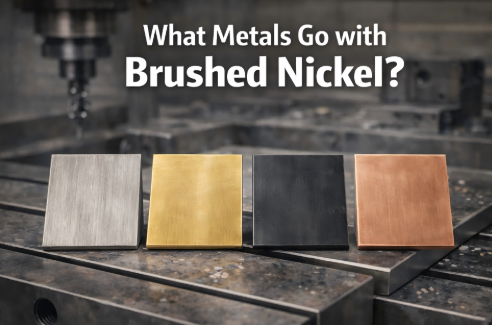
The best metal pairings for brushed nickel are brushed stainless steel and matte chrome plating. For more visual depth, aged brushed brass, brushed aluminum alloy, or matte black titanium can also work well. Polished metals and highly saturated metallic colors should be used only as small accents, not over large areas.
That is the conclusion up front.
Brushed nickel is not the kind of metal that shouts for attention. It is not glossy, flashy, or overpowering. Its strength lies precisely in its restraint. Refined. Subtle. Stable. It has a clear metallic character, yet it does not sharpen the feel of a space or product the way mirror-finish materials do. That is why it naturally works better as a “base material” than as an emotional or highly expressive one.
And because it is restrained, pairing it well requires more logic. Get it right, and the full hardware set, panel, or product exterior looks unified, clean, durable, and quietly upscale. Get it wrong, and the problem is not just that it “looks off.” You may also run into style conflicts, mismatched surface hierarchy, and even long-term issues such as oxidation, corrosion, or poor contact compatibility.
For manufacturing buyers, product designers, hardware specifiers, and appearance engineering teams, the real question is not whether they personally “like” a combination. What actually matters comes down to three things: Do the textures align? Do the tones feel unified? Can the materials remain compatible over time? This guide explains, in one place, which metals work with brushed nickel, why they work, where they fit best, and what practical details need attention.

1. Why Brushed Nickel Is One of the Most Versatile Metal Finishes
Brushed nickel is widely used not because it is the most expensive finish, and not because it is the brightest. It is used because it is exceptionally steady.
1.1 Visually, It Belongs to the “Low Contrast, High Texture” Category
The classic look of brushed nickel is a light silver-gray tone combined with a refined linear brushed texture. It does not reflect as aggressively as mirror chrome, and it does not force a style direction the way bright gold does. It feels more neutral. More restrained. More premium without trying too hard.
That means it naturally works well as a primary visual base.
It also means it is more tolerant of other metals than high-gloss finishes usually are.
1.2 In Performance, It Offers Solid All-Around Usability
Brushed nickel typically provides good corrosion resistance and oxidation resistance, with surface hardness that sits in a fairly balanced range. Whether used on interior hardware, furniture accents, kitchen and bath fittings, industrial panels, or certain electronic enclosures, it generally performs in a stable and reliable way.
So it is not just a finish that “looks good.”
It is a finish that can hold up in real use.
1.3 In Pairing, Its Biggest Enemy Is Not Simplicity. It Is Conflict
Many people worry that brushed nickel may look too plain. In practice, simplicity is not the issue. Disorder is.
Especially in a single product or space, once you start mixing matte, mirror, warm gold, cool silver, rough black iron, and polished plating all at once, the visual layers can quickly lose control. Brushed nickel is meant to stabilize the overall character. But once the surrounding materials become too loud, it starts to look awkward rather than refined.
So the real logic of pairing brushed nickel has never been “the more, the richer.”
It is “the more precise, the more premium.”
2. Understand the Core Traits of Brushed Nickel First, Then You Know What It Should Pair With
Material pairing is not random color matching. What usually determines compatibility comes down to three dimensions: texture, tone, and performance.
2.1 Texture Profile: Matte, Refined, Linear, and Controlled
The defining texture keywords of brushed nickel are clear:
- matte
- refined
- low reflectivity
- continuous grain
- a visually clean surface
That alone tells you something important. It works best with metals that are also matte, brushed, and refined in character. When the surface language is similar, the materials do not clash.
2.2 Tone Profile: Cool, Light, and Neutral
In color terms, brushed nickel falls into the cool-neutral family. It is not as bright as chrome, not as pale and lightweight-looking as aluminum, and not as sharply cold as some forms of stainless steel. It carries a slight gray softness, which makes it feel more gentle than many other cool-toned metals.
That is why it usually pairs more easily with cool-toned metals.
Warm-toned metals are not impossible, but they need more control.
2.3 Performance Profile: Better Matched with Stable Metals
Material pairing is not only about appearance. In hardware, equipment, outdoor components, kitchen and bath systems, and batch-produced products, long-term contact conditions matter. Different metals respond very differently to moisture, salts, temperature swings, cleaning agents, and prolonged contact.
That is why, in real applications, brushed nickel is better paired with metals that offer good corrosion resistance, stable surface behavior, and low maintenance demands. Otherwise, they may look coordinated at first, only to diverge badly in actual service.
3. Which Metals Pair Best with Brushed Nickel
Below, the options are ranked by general compatibility. This is not an absolute rule, but as a practical reference for engineering and appearance coordination, it works extremely well.
3.1 First Choice: Brushed Stainless Steel
This is one of the safest combinations.
Brushed stainless steel and brushed nickel speak almost the same surface language. Both are matte-leaning, finely textured, and cool-toned. When placed together, they do not compete, nor do they create the awkward contrast of “one very bright, one very muted.” The overall tonal balance stays stable, which makes this pairing especially suitable for modern, industrial, minimalist, and durability-driven product directions.
The main reasons this pairing works so well are:
- both share a brushed matte texture
- their tones are similar, creating visual unity
- both generally offer good corrosion resistance
- both are mature in engineering use and stable in batch production
Typical applications include:
- kitchen and bath hardware
- sinks and accessories
- furniture hardware
- industrial control panels
- decorative strips on equipment housings
- metal fittings in commercial spaces
If you do not want to take risks, choose this first.
It may not be the most dramatic option.
But it is often the most dependable one.
3.2 Second First-Choice Option: Matte Chrome Plating
Matte chrome is slightly brighter than brushed nickel, but as long as it stays within the matte family, the pairing remains very harmonious. Its advantage is not perfect sameness. Its strength lies in creating a light sense of layering within the same cool-toned system, without becoming flat or overly contrasty.
This pairing works especially well for smaller hardware pieces, because chrome-plated components often help small details look crisp and clean.
Its compatibility comes from:
- a similar matte surface feel
- a slightly brighter tone that adds gentle layering
- no strong conflict with brushed nickel
- strong suitability as a secondary metal
Common uses include:
- door locks
- bath faucets
- small connectors
- decorative caps
- small hardware accessories
One thing matters here: it needs to be matte.
Switch it to high-gloss mirror chrome, and the whole mood changes immediately.
4. Second-Tier Pairing Options: More Layered, but They Need Better Control
This group is not a compromise. In many cases, these combinations look excellent. They simply demand more attention to proportion, context, and detail.
4.1 Brushed Brass or Aged Brass
This is a classic warm-and-cool contrast pairing.
Brushed nickel leans cool, while brass leans warm. If both are treated in a matte, aged, or low-saturation brushed state, the contrast becomes soft rather than harsh. It adds depth instead of conflict. It feels vintage and refined rather than flashy.
It works especially well in settings such as:
- vintage-style furniture hardware
- lighting accessories
- premium handles
- certain hotel and display-space fittings
- decorative trim on panels
But two conditions are essential:
First, do not choose overly bright brass.
Second, do not spread it across large areas.
Once brass becomes too shiny, it overwhelms brushed nickel and makes the combination feel strained.
Aged, matte, and brushed finishes are the key.
4.2 Brushed Aluminum or Aluminum Alloy
If a project leans toward lightweight design, electronics, or a clean modern direction, brushed aluminum pairs very naturally with brushed nickel. Both are cool-toned metals, and their surface language echoes each other well. This is especially common on equipment housings, buttons, frames, control panels, and lightweight furniture.
The pairing logic mainly comes from:
- similar grain patterns and visual continuity
- close tonal values and strong overall unity
- aluminum’s lighter weight, which suits lightweight products
- strong compatibility with modern industrial and tech-oriented aesthetics
Typical applications include:
- electronic enclosures
- lighting fixtures
- lightweight furniture
- decorative parts for instruments
- industrial control interfaces
If the product emphasizes lightness, thinness, and simplicity, this combination feels very natural.
But if the project leans heavier, more classic, or more vintage, it may not be the best option.
4.3 Matte Black Titanium
This is a contrast-driven pairing. Used well, it looks extremely premium. Used poorly, it can feel stiff and forced.
The value of matte black titanium lies in its calm, restrained presence. It does not attack the eye the way glossy black does. When paired with brushed nickel, the combination essentially becomes a black-white-gray composition. Black titanium anchors the visual center of gravity, while brushed nickel softens and refines the detailing.
This pairing is especially suitable for:
- modern minimalist styles
- high-end hardware
- decorative panels
- furniture frames
- metal elements in commercial interiors
But again, the black titanium should also stay in the matte family.
If it becomes high-gloss mirror black, the balance with brushed nickel breaks almost instantly.
5. Materials That Can Be Used, but Only with Caution: Best Reserved for Accents
Some metals are not strictly incompatible with brushed nickel. The real problem is that they must not be overused. Once the proportions slip, the whole composition starts to lose its quality.
5.1 Polished Metals: Bright Chrome, Bright Nickel, and Mirror Stainless Steel
The problem with these materials is not their color. It is the way they reflect light. Brushed nickel produces diffuse reflection and feels soft. Polished metal creates mirror reflection and feels sharp. When the two are used side by side over large areas, the effect is like placing a mirror next to velvet. The rhythm is completely different.
That is why polished metals should only be used in small proportions, for example:
- screws
- small decorative caps
- ultra-thin narrow trims
- small control elements
A good guideline is to keep the ratio within 1:5.
In other words, the polished material should serve only as a supporting accent, never the dominant surface, and never split the visual field with brushed nickel on equal terms.
5.2 Colored Metals: Gold Plating and Rose Gold Plating
These finishes are stronger in personality and more style-specific. Used sparingly, they can add refinement. Used too much, they quickly feel cluttered, overly luxurious, or disconnected from the restrained character of brushed nickel.
So they are better suited to:
- jewelry components
- small premium decorative elements
- tiny highlight positions
They are not well suited to:
- large hardware surfaces
- large frame areas
- large primary panel colors
If brushed nickel is already the main material, colored metals need to be used with discipline.
6. Metals That Are Not Recommended for Large-Area Pairing with Brushed Nickel
This section matters because many projects fail not from choosing the wrong “first choice,” but from pulling unsuitable materials into the main material system.
6.1 Polished Gold and Polished Rose Gold
The problem here is not just a warm-versus-cool clash. It is also a clash of texture.
Brushed nickel communicates softness, refinement, and restraint. Polished gold and polished rose gold communicate reflectivity, glamour, and ornament. Once they sit side by side across large areas, brushed nickel starts to look dull, and the bright metal starts to feel gaudy. Neither side looks good.
If they must be used, keep them to very small accents.
For large-area mixing, they are not recommended.
6.2 Rough Cast Iron and Untreated Mild Carbon Steel
These materials are not automatically unusable in the same project, but if no surface coordination is done, placing them directly next to brushed nickel usually lowers the overall quality impression immediately.
The reasons are simple:
- the surface roughness levels are completely different
- their oxidation stability differs significantly
- one feels refined, the other raw
- one supports precision expression, the other leans toward a rough industrial aesthetic
If the project intentionally follows a rugged industrial language and the whole design is consistent, that is a different case.
But in most refined hardware, kitchen and bath, furniture, and equipment products, this combination is usually not suitable as a primary pairing.
7. What Principles Should Actually Guide Brushed Nickel Pairings
More important than memorizing a list of materials is remembering the rules. Once you know the rules, you can judge unfamiliar materials with reasonable confidence.
7.1 Look at Texture First, Not Color First
Many people instinctively look at color first. That is not enough.
The higher priority is usually whether the surface textures belong to the same visual family.
Matte with matte, brushed with brushed, refined with refined—this matters more than simply saying “they are both silver.”
Because visually, the way a surface reflects light is often more important than the color itself when it comes to perceived conflict.
7.2 Use Cool-Toned Metals as the Main System, and Warm-Toned Metals Only as Support
Brushed nickel itself sits in the cool-neutral range, so in most cases the main pairing materials should also come from the cool-toned family, such as:
- stainless steel
- aluminum alloy
- matte chrome plating
- black titanium
Warm-toned materials, such as brass, can certainly be added, but they work better as accents or style-driven supporting elements rather than as the main large-area system.
7.3 Control the Proportions. The Hierarchy Must Be Clear
This is one of the most frequently ignored rules.
If brushed nickel is the main material, it should ideally make up at least 70% of the visible metal system.
All supporting materials together should preferably stay within 30%.
The reason is simple. Once the material hierarchy becomes unclear, the visual center of gravity starts to scatter.
You may think the result looks rich.
The user often sees it as messy.
7.4 Performance Compatibility Must Not Be Ignored
This becomes especially important in environments such as:
- outdoor exposure
- humid kitchen and bath settings
- assemblies with long-term metal contact
- high-humidity, high-salt, or polluted environments
In these cases, appearance alone is not enough. You also have to think about corrosion resistance, electrochemical compatibility, maintenance frequency, and long-term surface change. If one material remains stable after years while the other darkens or oxidizes, even the best-looking combination at launch will eventually fail.
8. In Typical Applications, How Should Brushed Nickel Be Paired with Other Metals?
Theory matters, but real scenarios matter more. The following pairing logic is especially practical.
8.1 Kitchen and Bath: Brushed Nickel + Brushed Stainless Steel
This is the most classic and most recommended combination.
For example:
- brushed nickel faucets
- brushed stainless steel sinks
- brushed stainless steel storage racks
- brushed stainless steel hanging accessories
The strengths of this combination are obvious: clean, durable, timeless, and highly suitable for humid environments. For batch projects, it is also easier to control long-term consistency and maintenance experience.
8.2 Furniture Decoration: Brushed Nickel + Matte Black Titanium
This combination leans modern, premium, and spatially expressive.
It works well for:
- handles
- furniture frames
- cabinet hardware
- decorative trims
Black titanium provides the visual weight, while brushed nickel refines the detail. As long as the black side is not made too glossy, the result usually feels very well controlled.
8.3 Electronic Devices: Brushed Nickel + Brushed Aluminum Alloy
If the project emphasizes technology, lightweight construction, and consistency, this is a very natural combination.
For example:
- brushed nickel detail parts on a housing
- brushed aluminum alloy buttons
- brushed aluminum alloy frames
- decorative parts on control panels
This pairing is especially suitable for modern electronic devices, smart home products, and industrial interface systems.
8.4 Vintage Settings: Brushed Nickel + Aged Brushed Brass
If the project leans vintage, light luxury, English, French, or decorative in style, this combination has strong expressive value.
The key is not brass alone. The key is that the brass must stay restrained.
Aged.
Brushed.
Not high-gloss.
That way, the relationship between it and brushed nickel becomes one of character contrast rather than cheap collision.
9. What Practical Issues Need Attention to Avoid a Failed Pairing?
In real implementation, pairing problems usually do not come from theory. They come from execution details.
H3: 9.1 Confirm Surface Consistency Before Finalizing the Pairing
Even if two finishes are both called “brushed,” the grain thickness, directionality, haze, and reflectivity can vary significantly between suppliers, batches, and process settings.
So in batch projects, try to confirm:
- whether the brushing direction is consistent
- whether the gloss level is close
- whether the degree of refinement matches
- whether color variation is acceptable
Otherwise, what you thought was one coherent material system may arrive looking like two different product lines.
9.2 When Oxidation-Prone Metals Touch Brushed Nickel, Isolation Should Be Considered
Take brass as an example. If it remains in direct contact with brushed nickel over a long period, especially in a humid or electrolyte-rich environment, electrochemical corrosion risk may arise. It may not show up immediately, but it is a real long-term concern.
A more reliable approach is to:
- add insulating washers
- isolate direct contact
- optimize the assembly structure
- reduce environmental exposure where possible
This is especially important outdoors, in kitchens and baths, and in other high-humidity areas.
9.3 Material Pairings Must Obey the Overall Style
This sounds like a design concern, but in reality it is also an engineering concern.
If the overall style is modern minimalism, then cool tones, matte finishes, and clean lines should dominate.
If the overall style is decorative and vintage, then warm accents can be increased.
If it is industrial, some stronger and rougher material expression may be acceptable.
The point is not whether one material is “good” on its own.
The point is whether it is speaking the same visual language as the rest.
10. Common Questions: The Ones Procurement and Design Teams Ask Most Often
10.1 Can Brushed Nickel Be Paired with Copper?
Yes.
More precisely, it is better paired with matte, aged, or brushed brass-like copper tones.
If the copper tone is too bright, or if the area is too large, it tends to fight with brushed nickel. A small proportion, low gloss, and a more vintage direction usually work better.
10.2 In Outdoor Settings, What Metal Pairs Best with Brushed Nickel?
Brushed stainless steel should usually be the first choice.
The reason is practical: it offers more stable corrosion resistance, stronger aging resistance, and better suitability for rain, temperature swings, and long-term exposure. In visual terms as well, stainless steel is one of the easiest metals to keep aligned with brushed nickel.
10.3 Will Brushed Nickel Look Messy When Paired with Polished Metal?
In small accent proportions, usually not. Bright screws, tiny decorative details, and narrow trims are often acceptable.
But once the polished metal area becomes large, problems usually start.
That is because the conflict between polished and matte is not just a detail-level issue. It affects the whole visual system.
So it is not that they can never be mixed.
It is that they must not be mixed too much.
11. Conclusion: When Pairing with Brushed Nickel, the Key Is Not More. It Is Accuracy
At its core, brushed nickel is a metal finish that works extremely well as a primary material. It is refined, restrained, stable, and very well suited to many modern products and hardware applications.
When pairing it with other metals, the real task is not to “find the most expensive material.” It is to get three things right:
- texture coordination
- tone unity
- proportional balance
If you want the safest approach, start with brushed stainless steel and matte chrome plating.
If you want more depth, consider aged brushed brass, brushed aluminum alloy, and matte black titanium.
If you use polished metals or colored metallic finishes, treat them as accents only, never as the leading role.
The most premium material combinations are usually not the ones that shock at first glance.
They are the ones that feel more right the longer you look at them.
And the more stable they become over time.
FAQ Section
12. Frequently Asked Questions
12.1 What Metal Pairs Best with Brushed Nickel?
Brushed stainless steel and matte chrome plating are usually the best choices because they are closest to brushed nickel in texture, tone, and corrosion resistance. The overall result feels more unified and is much less likely to go wrong.
12.2 Can Brushed Nickel Be Paired with Brass?
Yes, but matte, aged, or brushed brass is strongly preferred, and it should usually be used only as a small accent. That makes it easier to create soft layering without disrupting the understated character of brushed nickel.
12.3 Is Brushed Nickel Suitable for Use with Aluminum Alloy?
Yes, especially with brushed aluminum or brushed aluminum alloy. Both belong to a cool-toned, refined metal family, making them well suited to electronic devices, lighting, and lightweight furniture applications.
12.4 Why Is Brushed Nickel Not Suitable for Large-Area Pairing with Polished Metals?
Because polished and matte surfaces follow very different reflection logic. When mixed across large areas, the visual conflict becomes much stronger, and the overall result tends to feel cluttered, fragmented, and less premium.
12.5 In Outdoor Environments, What Metal Is Best Paired with Brushed Nickel?
Brushed stainless steel is usually the preferred choice. It generally offers stronger corrosion resistance, better aging resistance, and better long-term stability outdoors, while also maintaining a surface character that aligns easily with brushed nickel.
12.6 What Is the Most Important Rule When Pairing Brushed Nickel with Other Metals?
The three most important principles are usually texture harmony, tonal unity, and balanced proportions. More specifically, matte should pair with matte, cool tones should lead, warm tones should accent, and supporting materials should stay controlled in area.