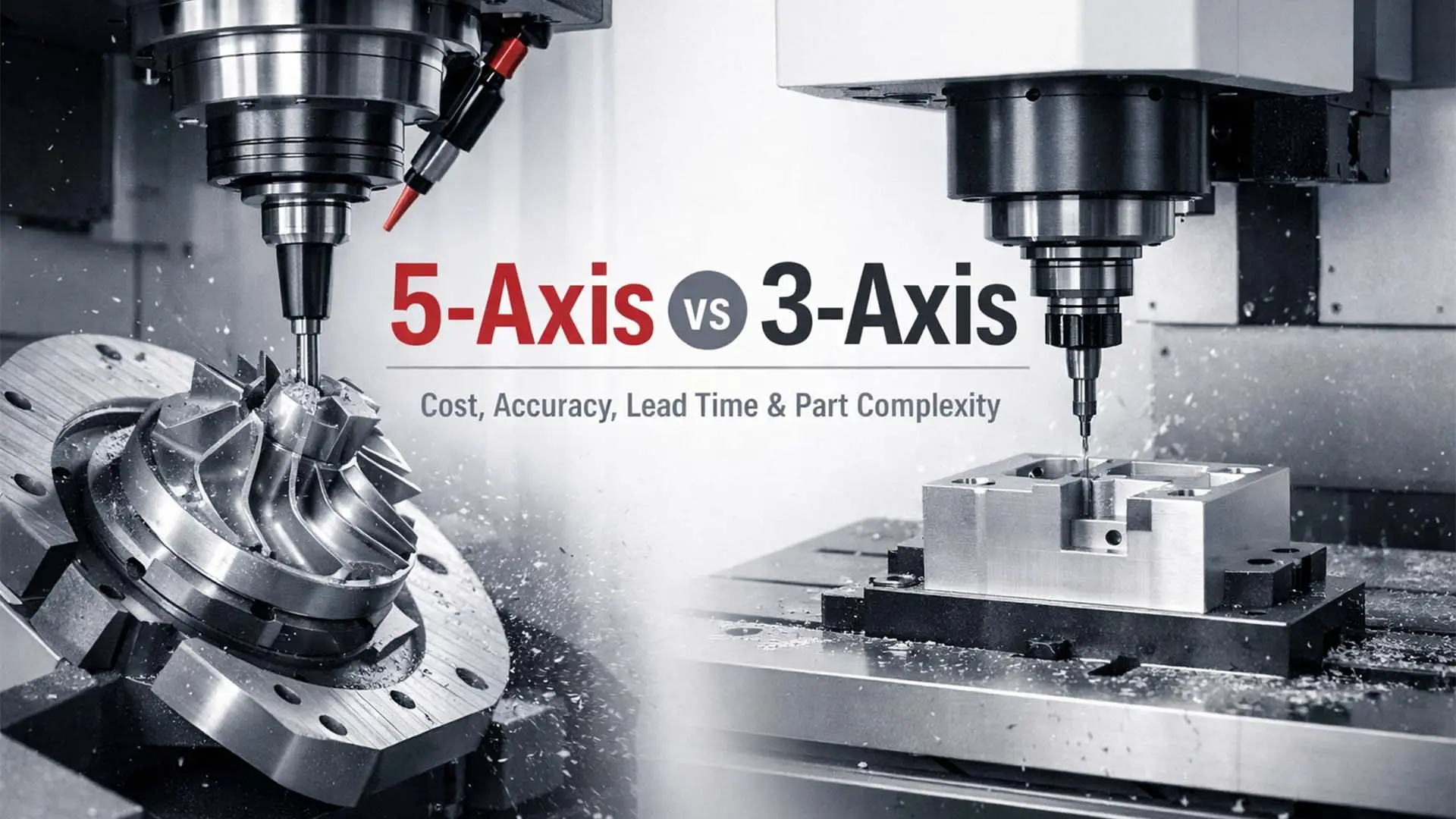
When reviewing drawings and comparing suppliers, the most common tension is this: “3-axis is more economical for simple parts,” while “for complex curved surfaces, 5-axis is the safer choice.” This comparison looks at geometric accessibility, single-setup capability, programming difficulty, fixturing and changeover, machine-hour rates and TCO, lead time and batch size, as well as the boundary between 3+2 positioning and simultaneous 5-axis machining, so you can make a clearer decision on whether 5-axis is truly necessary.
1. Quick Conclusions and Best-Fit Scenarios
- For regular geometries, limited side features, and high-volume production with strong repeatability, 3-axis is the most economical option.
- For deep multi-face cavities or continuous freeform surfaces with demanding requirements for dimensional accuracy and surface quality, 5-axis should be prioritized. For complex surfaces, simultaneous 5-axis is generally the better choice.
- For multi-face parts with fixed angles and low requirements for surface continuity, 3+2 offers a practical balance between capability and cost.
- If the goal is to reduce outsourcing, minimize setups, and shorten turnaround time, a one-stop solution combining 5-axis machining, EDM, and turning is worth prioritizing.
2. Core Comparison Table: 5-Axis vs. 3-Axis
The table below compares 3-axis, 3+2 positioning, and simultaneous 5-axis machining across the same set of criteria, making it easier for engineering and procurement teams to align on a common evaluation standard. Cost items and price ranges are for reference only. Differences by region and machine configuration are significant. Data is current as of March 2026.
| Dimension | 3-Axis | 3+2 Positioning | Simultaneous 5-Axis |
| Machining type | Linear interpolation in X, Y, and Z | Two rotary axes are used for positioning, followed by 3-axis cutting | X, Y, Z and two rotary axes interpolate simultaneously |
| Geometric accessibility and single setup | Multiple sides require repeated flipping and datum rebuilding | Multi-angle positioning reduces the number of flips | Covers the most surfaces in a single setup; deep cavities, steep walls, and undercut-like features are more controllable |
| Typical accuracy and surface finish | Regular geometries can be kept stable at assembly-grade accuracy; surface Ra depends on tooling and parameters | Better positional consistency across multiple faces | Continuous surfaces can be cut closer to the surface normal, making Ra easier to stabilize and overall consistency stronger |
| Programming complexity | Low and easy to implement | Medium, with added handling for multiple orientations and post-processing | High, requiring tool-axis control, simulation, and collision-avoidance strategy |
| Fixturing and changeover | Relies on multiple setups; dedicated fixture cost may be relatively high | Moderate, though fixture planning is still important | Fewer setups, but higher demands on datum rigidity and tool setting |
| Typical machine-hour rate | Lower, commonly around USD 10–20/hour | Mid-range, depending on machine configuration | Higher, commonly around USD 25–30/hour or more |
| Batch size and cycle efficiency | Strong advantages in large-volume production and line reuse | Balanced performance in small to medium batches | Clear cycle-time advantages for complex prototypes and small to medium batches |
| Material and tooling strategy | More forgiving for aluminum and common steels; deep cavities require long tools | Performance on difficult materials depends on how accessible the machining orientation is | Titanium and nickel-based alloys are easier to control in terms of tool behavior and surface finish when the orientation and cooling strategy are right |
| Automation potential | Easy to scale with parallel production and automated loading/unloading | Can be combined with pallet systems to improve OEE | Can support unattended night-shift operation with pallets and robots, but requires stronger process control |
| Compliance and traceability | Can support ISO, FAI, and similar workflows | Same as at left | Same as at left, with surface-part consistency generally easier to validate |
| Recommended applications | Flat surfaces, slots, holes, standard prismatic housings | Multi-face parts, fixed-angle structural parts, mold-type components | Impellers, blades, medical implants, complex cores, deep cavities, steep walls |
For background and technical principles, Autodesk’s Chinese Help Center provides useful references on the definitions and strategies behind 3+2 and simultaneous 5-axis machining. For controller logic related to tool center point control and normal-direction cutting, official technical documents from HEIDENHAIN and FANUC are also helpful. See the references at the end of this article.
3. Scenario-Based Selection and Decision Logic
A complex decision becomes much easier if you break it into three steps.
- If the part includes continuous freeform surfaces or deep cavities, and both tolerance and surface quality matter, simultaneous 5-axis should be your first choice.
- Otherwise, if the part can be broken down into a limited number of fixed orientations and surface continuity is not especially critical, 3+2 positioning is usually the better option.
- Otherwise, if the geometry is regular and the production volume is high, with strong demand for repeatability and line-style production, 3-axis is the right fit.
- If the job spans multiple processes and you want to reduce outsourced operations and repeated setups, a one-stop approach that combines 5-axis machining, EDM, and turning can shorten turnaround time and reduce accumulated error.
The logic behind this approach is simple: prioritize accessibility and single-setup capability first. The more features you can cover in one setup, the less datum rebuilding and flip-related error you introduce. That makes improvements in Ra and geometric consistency more predictable. When surfaces are continuous and angle changes are frequent, simultaneous 5-axis machining uses real-time tool-axis control and RTCP to keep the tool tip moving steadily along the target path, helping prevent overcutting and undercutting.
4. Cost and TCO Breakdown, Plus Single-Part Estimation
The first step is to define the cost structure clearly. Total cost usually includes machine-hour rate multiplied by machining time, programming and setup, fixture cost and amortization, tooling consumables, inspection, scrap and rework, post-processing, and logistics. Public Chinese-language sources commonly report 3-axis machining rates in China at around USD 10–20 per hour, while 4-axis and 5-axis rates are often around USD 25–30 per hour or higher. Regional and machine-specific differences are significant, so quotations should always be based on the actual drawing and process details. The figures here are referenced as of March 2026.
A reusable unit-cost model looks like this:
- Total unit cost ≈ machine-hour rate × machining time + programming and setup + fixture amortization + tooling consumables + inspection + scrap rate × rework cost + post-processing and logistics
- The key difference between 3-axis and 5-axis is that although 5-axis has a higher nominal machine-hour rate, it can often reduce part flipping, dedicated fixturing, and the hidden cost of scrap and rework because more features are completed in a single setup. For complex surface parts, the total cost of ownership of 5-axis is not necessarily higher.
When evaluating TCO, do not focus only on the nominal machine-hour rate. Put setup count, number of flips, programming reusability, yield, and rework rate into the same comparison sheet. That will give you a much clearer picture of which route is actually more stable.
5. Engineering Priorities in Programming and Quality Validation
- Programming complexity and front-end preparation: Simultaneous 5-axis machining requires a mature post-processor, reliable simulation, and well-developed collision-avoidance logic. The experience threshold for engineering is clearly higher. By contrast, 3+2 can often deliver strong results with lower programming complexity when the required machining orientations are accessible.
- RTCP and normal-direction cutting: In tilted 5-axis machining, tool center point control and real-time compensation allow the tool tip to follow the intended path more steadily. This is especially important for maintaining Ra and geometric consistency on continuous surfaces.
- Tooling and material strategy: For difficult-to-machine materials such as titanium alloys and nickel-based alloys, cutting speed, feed per tooth, axial and radial depth of cut, and cooling strategy all need to be matched carefully. Simultaneous 5-axis machining can shorten the effective tool length, optimize the working angle, and work better with high-pressure coolant, improving tool life and surface consistency.
- Quality and compliance: ISO 9001, FAI, and PPAP are not requirements unique to 5-axis machining. However, when more features can be completed in a single setup, critical dimensions are often easier to inspect and validate within one consistent datum system.
6. Frequently Asked Questions
Is 5-axis overkill for simple parts?
If the geometry is regular and the production volume is high, the higher hourly rate and greater programming effort of 5-axis are often difficult to justify. In those cases, 3-axis or 3+2 is usually the more cost-effective solution. The real value of 5-axis appears when accessibility and single-setup coverage become important.
How can I estimate unit cost quickly during RFQ evaluation?
Start with a rough estimate based on machine-hour rate multiplied by machining time. Then add programming and setup, fixture amortization, tooling, inspection, and expected rework into the same sheet. For a 5-axis option, also evaluate the reduction in flips, fixture investment, and scrap risk. Those factors often offset part of the hourly-rate gap.
When should I choose 3+2 instead of simultaneous 5-axis?
When a part consists of a limited number of fixed-angle faces and relatively simple curved features, and there is no strong requirement for continuous surface blending or true tool-axis-following control, 3+2 is often the more efficient and economical choice.
What is the practical difference between 5-axis and 3-axis on difficult materials?
Titanium and nickel-based alloys are more sensitive to tool orientation, tool length, and cooling. By controlling the tool axis and entry angle, simultaneous 5-axis machining can reduce effective tool overhang, improve the cutting angle, and work better with high-pressure coolant. That usually leads to better tool life and more stable surface quality.
7. References and Further Reading
- For official definitions and strategies related to multi-axis machining, see Autodesk’s Chinese Help Center. You can search the site for entries on 3+2 machining and simultaneous 5-axis strategies as a reliable reference for process planning. Autodesk Chinese Help Center: https://help.autodesk.com/CHS/
- For controller support related to tool center point control and normal-direction cutting, HEIDENHAIN China’s download center provides TCPM and TNC manuals that explain the control principles and command logic. HEIDENHAIN Download Center and TNC Manuals: https://www.heidenhain.com.cn/service/download-center/
- FANUC China also provides information relevant to functions such as G43.4 and RTCP, which are useful for understanding dynamic tool-tip compensation in 5-axis machining. FANUC China: https://www.fanuc.com.cn/
- For Chinese-language background reading on CNC cost structure and typical machine-hour pricing, Chiggo offers useful breakdowns and example ranges. Chiggo article on CNC machining cost reduction: https://chiggofactory.com/zh-CN/tips-to-reduce-cnc-machining-cost/
- For general educational reading on 5-axis principles and quotation logic, LSRPF also provides a useful Chinese-language article. LSRPF guide to how 5-axis CNC machining works: https://www.lsrpf.com/zh-Hans/blog/how-does-5-axis-cnc-machining-work
Note: Pricing and efficiency data vary significantly by region, machine type, configuration, and exchange rate. Final evaluation should always be based on the drawing and current production conditions. The pricing references and source update points cited in this article are based on March 2026.
8. Another Option to Consider
If your project involves complex geometry and would benefit from broader single-setup coverage while reducing setup count and outsourcing risk, it may be worth considering a supplier with one-stop capabilities in 5-axis machining, EDM, and turning, backed by an ISO 9001 quality system. A supplier such as Daxin CNC, for example, may provide a more stable delivery path from prototyping to small and medium batch production, especially when engineering changes require tighter turnaround control. Visit the website to review the scope of capabilities:https://www.changfangcn.com/