This guide explains the relationship between press fitting and interference fits, common interference ranges, standard fit designations such as H7/p6 through H7/u6, adjustment methods for different materials, and practical points for batch assembly.
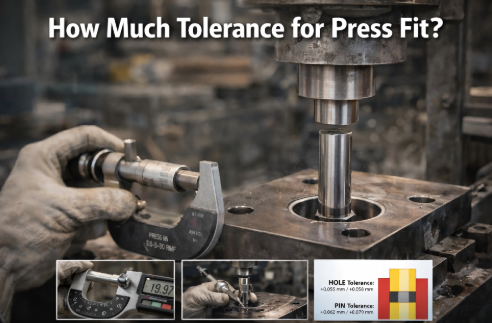
Press-fit tolerance is not a single fixed number. In essence, it is a controlled dimensional range built around the required interference value. For most precision parts, press-fit success is not simply a matter of whether the components can be forced together. What really matters is how much larger the shaft is than the hole. If the interference is too small, the assembled parts may loosen or fall out. If it is too large, assembly becomes difficult and the hole wall may crack or the part may be damaged. The conclusion is straightforward: press-fit tolerance should be determined by diameter, adjusted by material, and fine-tuned according to service conditions.
For manufacturers, purchasing managers, and engineering teams dealing with batch production and long-term assembly stability, press-fit tolerance is never a minor parameter. It directly affects assembly force, concentricity, anti-loosening performance, rework rate, batch consistency, and overall delivery risk.
At the sample stage, many problems stay hidden. In mass production, everything changes. Parts loosen. Parts crack. Assemblies skew. Components jam. The first sample may go together fine, but production becomes unstable. In many cases, the root cause is weak control over press-fit tolerance.

1. Basic Understanding of Press Fits
A press fit is a typical application of an interference fit. It is an assembly method that creates a secure connection by means of dimensional interference between a shaft and a hole. It does not rely on screws, glue, or welding. Instead, it depends on compressive force and contact pressure between the materials to create a tight hold.
Put simply, the hole is slightly smaller and the shaft is slightly larger. Once assembled, the material undergoes slight elastic deformation and forms a stable connection.
This method is widely used in CNC precision parts, bearing seats, bushings, gear hubs, hardware components, and structural assemblies for very practical reasons: the structure remains compact, the joint stays stable, concentricity is often better, and relative rotation or displacement after assembly is less likely.
But there is one condition.
The tolerance has to be controlled correctly.
2. Key Press-Fit Terms Explained
Before discussing press-fit tolerance, it is important to define several key terms clearly. Many assembly failures are not caused by poor pressing technique, but by misunderstanding the fundamentals from the beginning.
2.1 What Is a Press Fit?
A press fit means that the actual outer diameter of the shaft is slightly larger than the actual inner diameter of the hole. The shaft is then pressed into the hole with a press or controlled assembly force to create an interference connection.
After assembly, continuous contact pressure generates the holding force needed to ensure:
2.1.1 Stable Connection
The parts are not easily loosened or pulled apart after assembly.
2.1.2 Better Concentricity Control
Provided that the machining accuracy of the shaft and hole is good enough.
2.1.3 No Relative Rotational Movement
This makes it suitable for structures that must resist slipping or spinning.
2.2 What Is Interference Value?
The interference value is the core parameter in press-fit tolerance.
Its definition is simple:
Interference value = actual shaft outer diameter – actual hole inner diameter
For example, if a shaft is made to 25.018 mm and the hole is made to 25.000 mm, the theoretical interference value is 0.018 mm.
That value may look small.
For precision assemblies, however, it can be the difference between a reliable fit, a loose fit, or a scrapped part.
2.3 What Is Press-Fit Tolerance?
Press-fit tolerance does not mean controlling only the shaft, nor only the hole. It means using the tolerance zones of both parts together to ensure that the actual assembled interference falls within a reasonable range.
This point is critical.
In batch production, it is common to see a misleading situation: the hole is individually qualified, and the shaft is individually qualified as well, yet some assemblies still come out too tight while others are too loose. The issue is not that the dimensions were not achieved. The issue is that the tolerance stack itself was designed poorly.
2.4 Where Are Press Fits Typically Used?
Press fits are commonly used in the following applications:
2.4.1 Static Retention Connections
Such as fixed bushings, sleeves, collars, and mandrels.
2.4.2 Vibration Environments
Where the connection must remain secure under long-term vibration.
2.4.3 High-Speed Rotating Structures
Such as gears, bearing-related locations, and rotating component interfaces.
2.4.4 Assemblies Requiring High Concentricity
A press-fit approach helps maintain better shaft-hole center alignment.
3. Standard Reference Ranges for Press-Fit Tolerance
This is the most practical part of the discussion, and also the most directly useful.
The core rule is this: for conventional precision press fits, the interference value can often be estimated initially at about one-thousandth of the fit diameter, then adjusted based on material, wall thickness, loading, and assembly method.
It is not the only formula.
But it is extremely useful.
3.1 Reference Interference Ranges for Common Size Groups
The following ranges apply to most standard steel parts, room-temperature conditions, normal loading, and conventional precision machining. If the material is soft, the wall is thin, or the structure is unusual, further adjustment is necessary.
3.1.1 Fit Diameter ≤ 10 mm
Recommended interference: 0.005 – 0.015 mm
Small parts offer very limited room for deformation, so interference must not be too large. This is especially true for miniature precision bushings, small shafts, and thin-wall small-hole parts, where even slightly excessive interference can cause distortion, jamming, or cracks.
3.1.2 Fit Diameter 10 – 30 mm
Recommended interference: 0.010 – 0.030 mm
This is the most common range in practice. Many bushings, locating elements, gear bores, bearing seats, and precision connecting parts fall into this size group. The range usually balances assembly feasibility with holding strength and is therefore widely used.
3.1.3 Fit Diameter 30 – 50 mm
Recommended interference: 0.020 – 0.040 mm
Once the size moves into the medium range, the contact surface grows and the allowable interference can increase accordingly. But at this stage, diameter alone is not enough. Wall thickness, material, and outer structure all matter. A thin-wall part cannot tolerate the same press fit as a thick solid section.
3.1.4 Fit Diameter 50 – 100 mm
Recommended interference: 0.030 – 0.060 mm
This size range is typical for larger shafts, hubs, sleeves, and load-bearing structural connections. Where vibration, shock, long-term operation, or high torque are involved, values in the upper portion of the range are often chosen. On the other hand, if the hole component is brittle or structurally weak, the interference must not be increased blindly.
3.2 A Very Common Rule of Thumb
In engineering practice, a simple but effective starting point is often used:
Interference value ≈ fit diameter × 0.001
For example:
- For a diameter of 20 mm, a starting interference value of about 0.020 mm may be considered
- For a diameter of 40 mm, a starting interference value of about 0.040 mm may be considered
- For a diameter of 80 mm, a starting value of about 0.080 mm may be considered, though this usually needs to be reduced depending on material and working conditions
This rule of thumb is not a replacement for fit tables. It is a fast reference point. Once that baseline exists, engineering judgment becomes much more stable.
3.3 Standard Fit Designations for Reference
Under the basic hole system, the following fit designations are commonly used for press-fit design. For projects that require a shared technical language between supplier, engineering team, and inspection team, this section matters a great deal.
3.3.1 Light Press Fits: H7/p6, H7/r6
These represent relatively small interference values.
They are easier to assemble, provide decent resistance to loosening, and do not impose excessive assembly stress on the parts. They are suitable for light-duty connections, general locating components, and applications that need a balance between ease of pressing and connection stability.
3.3.2 Medium Press Fits: H7/s6, H7/t6
This is the most common and practical group.
The holding force is moderate, reliability is good, and the application range is broad. Many conventional industrial assemblies, CNC precision components, and shaft-hole interference joints begin with this class as the preferred option.
3.3.3 Heavy Press Fits: H7/u6
This class represents relatively large interference.
Its advantage is strong holding power, making it better suited to high loads, strong vibration, high torque, and long-term operation. The downside is equally clear: assembly becomes more difficult, and the demands on material, wall thickness, roundness, concentricity, surface finish, and assembly process all rise sharply.
It can be used.
But it should not be chosen casually.
4. How Press-Fit Tolerances Should Be Adjusted for Different Materials
One of the most common mistakes in press-fit design is treating all materials as if they behave like steel. That is a classic misconception.
Different materials have very different elastic modulus, yield behavior, brittleness, toughness, and thermal expansion characteristics. The same interference value can produce completely different results in different material combinations.
4.1 Steel-to-Steel Press Fits
Steel-to-steel is the most common and the easiest combination to standardize.
Because steel offers high strength and relatively stable toughness and load-bearing capacity, the general reference ranges discussed earlier can usually be applied. As long as wall thickness is adequate, roundness and concentricity are within tolerance, and the surface condition is good, steel-on-steel combinations can usually tolerate medium or even relatively high interference.
That is why most standard tables are effectively based on steel-to-steel conditions.
4.2 Steel-to-Aluminum Press Fits
This combination is very common in lightweight equipment, automation structures, robotic parts, and high-end hardware.
It is also a frequent source of failure.
Aluminum alloys are softer and more prone to local plastic deformation. The hole wall and edge regions are much less capable of تحمل assembly stress than steel. If steel-on-steel interference values are applied directly, the result may be edge flaring, local crushing, bulging cracks, or overall distortion.
For that reason, steel-to-aluminum interference is often reduced to roughly half of a steel-to-steel value as an initial guide, then adjusted further according to wall thickness, engagement length, and service load.
4.3 Steel-to-Plastic / Nylon / Polymer Press Fits
This combination requires extreme caution.
Plastics, nylon, PC, and similar materials have lower stiffness, more creep, and a higher tendency to crack under local stress concentration. Thin walls, notches, or sharp transitions make the risk even worse. Traditional large-interference press fits are often unsafe in such materials.
A common recommended range is: 0.002 – 0.010 mm
In some cases, it is better not to use a standard press fit at all. A transition fit, insert design, thermal insertion, or snap-fit structure may be far more reliable.
4.4 Cast Iron Press Fits
Cast iron can offer good rigidity, but it is relatively brittle. Gray cast iron in particular is highly sensitive to local tensile stress. If the interference is too large, edge chipping, hidden cracks, and local breakage can occur.
For that reason, press fits in cast iron are generally recommended to use smaller interference values, not aggressive ones. Particular attention should be paid to chamfers, edge notches, and wall thickness uniformity before assembly.
5. How to Optimize Tolerances for Different Working Conditions
Even when the material and diameter are the same, the tolerance should not be set identically across all applications. A reliable press-fit design must always reflect the service condition.
5.1 Room-Temperature Static Conditions
If the part operates at room temperature, under static load, without obvious shock or vibration, then a smaller interference value is often appropriate.
The advantage is easier assembly, lower part stress, and a smoother assembly rhythm. For many standard locating and fixed components, that is often sufficient.
5.2 Vibration or High-Speed Operation
If the application involves continuous vibration, high-speed rotation, or cyclic shock, then a larger interference value should be considered.
The reason is straightforward. Under dynamic conditions, the interface is more likely to relax over time. If the holding force is insufficient, the assembly may gradually loosen, spin, shift, or generate noise.
5.3 Assemblies That Need Repeated Disassembly
If the part will need later maintenance, repeated removal, or replacement, it is usually unwise to use an aggressively strong press fit.
In such cases, it is better to reduce the interference or even switch to a transition fit. A heavy interference fit may hold well the first time, but repeated disassembly can damage the mating surfaces and eventually destroy dimensional stability.
5.4 High-Temperature Working Environments
At elevated temperatures, materials expand, and different materials expand at different rates. If that is ignored during design, a fit that seems appropriate at room temperature may loosen once the assembly reaches operating temperature.
That is why high-temperature applications often require a slightly larger interference value to compensate for thermal expansion and contraction effects. But this must always be considered together with the material pairing. It should never be increased mechanically without thought.
6. Practical Points to Watch in Press-Fit Tolerance Control
Getting the tolerance right on the drawing does not guarantee that assembly will go well in practice. Stable press-fit execution depends just as much on machining quality and process control.
6.1 Control the Mating Surface Quality
The press-fit surfaces must be smooth and free from burrs, tool marks, scratches, dents, and raised defects. Otherwise, even if the nominal dimensions are correct, local interference can become excessive during assembly, causing uneven force, jamming, or damage.
Surface roughness may look like a detail.
In reality, it matters a lot.
6.2 Do Not Ignore Geometric Tolerances
Many press-fit failures are not caused by the basic dimensions being wrong, but by roundness, cylindricity, or concentricity falling out of spec.
A part can pass dimensional inspection and still fail in assembly. If the roundness is poor or the axis is off, the fit may skew, gall, jam, or create abnormal local pressure during pressing.
6.3 Use the Correct Assembly Method
Press fits should ideally be assembled with a press and a smooth, controlled insertion force, not by impact.
Hammering may sometimes appear to work, but it greatly increases the risk of skewing, edge damage, cracking, and abnormal internal stress. For larger interference values, auxiliary assembly methods are often very effective:
6.3.1 Cooling the Shaft
This allows the shaft to shrink slightly and reduces assembly resistance.
6.3.2 Heating the Hole Component
This allows the hole to expand slightly and helps with assembly.
Thermal assistance of this kind is especially useful in larger sizes or higher-interference applications.
6.4 Batch Production Requires First-Article Verification
In batch production, the worst mistake is not a flawed theory. It is skipping first-article validation and going straight to production.
The right approach is to measure the actual shaft and hole dimensions on the first article, calculate and confirm the real interference value, verify the pressing force, concentricity, appearance, and assembly condition, and only then move into mass production. Otherwise, if the tolerance zones have been combined poorly, an entire batch may be scrapped.
7. Common Press-Fit Problems and How to Solve Them
Press-fit issues are not rare. The key is identifying whether the root cause lies in size, tolerance, geometry, material, or assembly process.
7.1 Parts Become Loose or Fall Out
The most common reason is insufficient interference.
The shaft may be undersized. The hole may be oversized. Or both may be individually acceptable while the combined fit is still too weak. Common solutions include:
7.1.1 Rework the Shaft and Increase Its Size Slightly
This raises the final interference value.
7.1.2 Reevaluate the Tolerance Zone Combination
It may be necessary to move from H7/p6 to a tighter combination such as H7/s6.
7.1.3 Check Whether the Actual Working Conditions Are More Severe Than Expected
If vibration or thermal rise exists in practice, the fit should be redesigned accordingly.
7.2 Difficult Assembly or Part Cracking
This usually means the interference value is too large, or the material and structure cannot tolerate the stress.
Typical solutions include:
7.2.1 Reduce the Shaft Size
Bring the actual interference back into a reasonable range.
7.2.2 Switch to a Looser Fit Designation
For example, change from H7/u6 to H7/t6 or H7/s6.
7.2.3 Check Whether the Material and Wall Thickness Suit the Current Design
This is especially important for aluminum parts, plastic parts, and thin-wall hole components, where steel-based assumptions often fail.
7.3 Skewed Pressing or Uneven Load Distribution
In many cases, this problem is not caused by the size of the interference itself, but by inadequate geometric accuracy.
The main checks are:
7.3.1 Whether the Mating Surface Roundness Is Acceptable
Local ovality can directly cause jamming during assembly.
7.3.2 Whether Concentricity Is Within Spec
If the axes are off, the parts will press in more crookedly the farther the assembly progresses.
7.3.3 Whether the CNC Machining Process Is Stable
This includes clamping distortion, tool wear, and hole-machining strategy.
8. Why Batch Purchasing Projects Should Pay More Attention to Press-Fit Tolerance Design
For a single sample, getting the parts pressed together may be enough. In many cases, experienced operators can still “save it” on the spot.
Batch production does not work that way.
In volume assembly, what really matters is that every part presses in consistently, stays tight after assembly, maintains concentricity, supports a controllable assembly rhythm, and avoids local chipping or hidden damage. In other words, press-fit tolerance must be designed for mass production from the beginning, not merely for trial assembly.
From a supply chain perspective, a mature precision machining manufacturer should do more than simply produce shafts and holes. It should also have the following capabilities:
8.1 The Ability to Evaluate a Reasonable Fit Strategy
Not just applying tables mechanically, but giving practical tolerance recommendations based on material, wall thickness, engagement length, and service conditions.
8.2 Stable Control of Size and Geometric Accuracy
Because for press-fit projects, size alone is never enough. Roundness, concentricity, and surface condition are equally important.
8.3 The Ability to Perform First-Article Validation and Maintain Batch Consistency
First-article verification, assembly trials, dimensional confirmation, and in-process sampling are all essential.
8.4 The Ability to Trace Problems Quickly When They Appear
Was the shaft too large? Was the hole too small? Was the roughness wrong? Did the material exceed its stress limit? Fast diagnosis is the only way to avoid repeated rework.
9. Conclusion: The Core of Press-Fit Tolerance Is Not Memorizing Numbers, but Building the Right Judgment Logic
There is no single fixed value for press-fit tolerance. A reliable design logic always revolves around three things: set the baseline by diameter, adjust by material, and tune the fit according to service conditions.
For conventional steel parts, estimating interference at roughly one-thousandth of the fit diameter is a strong starting point.
For softer or more brittle materials, the interference must be reduced significantly.
For high vibration, high speed, elevated temperature, or long-term operation, the design must be corrected further.
Only when this is combined with standard fit designations, stable CNC machining capability, proper assembly methods, and strict first-article verification can a press fit truly become secure, damage-free, and stable, rather than simply “forced together by luck.”
FAQ
1. What should press-fit tolerance be?
There is no single fixed value. For standard precision metal parts, a useful starting reference is about one-thousandth of the fit diameter, then adjusted according to material, wall thickness, working conditions, and assembly method.
2. Is a press fit the same as an interference fit?
A press fit is typically one practical form of an interference fit. Both rely on the interference between shaft and hole to create a secure connection, but a press fit emphasizes the actual pressing assembly process.
3. What is the difference between H7/p6, H7/s6, and H7/u6?
They represent different levels of interference fit. H7/p6 and H7/r6 are lighter-duty fits and are easier to assemble. H7/s6 and H7/t6 are common medium-duty choices. H7/u6 provides larger interference and suits heavier loads, but assembly becomes more demanding.
4. How should tolerance be adjusted for a steel-to-aluminum press fit?
It should usually be more conservative than a steel-to-steel fit. A practical starting point is often around half the steel-to-steel interference value, then adjusted according to aluminum wall thickness, engagement length, and structural strength.
5. Can plastic parts use a press fit?
Yes, but very carefully. Plastics, nylon, and PC usually require very small interference values, often around 0.002 – 0.010 mm. In many cases, a transition fit or insert-based structure is a better solution.
6. What should I do if a press fit is too tight?
First check whether the actual shaft-hole combination creates excessive interference. Then reduce the shaft size, adjust the fit designation if needed, or use assembly assistance such as cooling the shaft or heating the hole component.
7. What should I do if a press fit is too loose?
This usually means the interference value is insufficient. Check whether the shaft is too small or the hole too large. If necessary, redesign the tolerance zones or choose a tighter standard fit designation.
8. Why can a press fit still skew or jam if the dimensions are qualified?
Because press-fit performance depends not only on basic size, but also on roundness, cylindricity, concentricity, surface roughness, and assembly method. Passing dimensional inspection alone does not guarantee smooth assembly.